Responding to the Threat of Violent Extremism by Paul Thomas
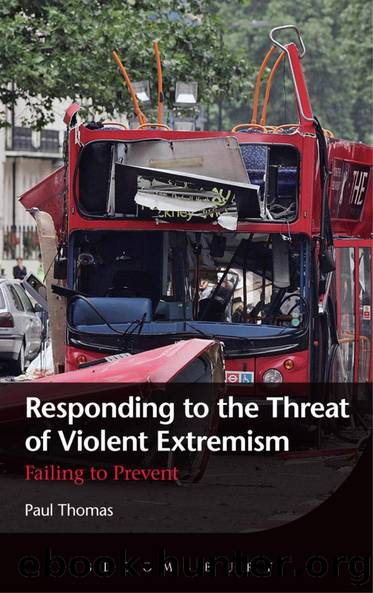
Author:Paul Thomas [Thomas, Paul]
Language: eng
Format: epub
ISBN: 9781849665254
Barnesnoble:
Publisher: Bloomsbury Academic
Published: 2012-04-10T00:00:00+00:00
Whilst addressing discussions around surveillance and political interference, this crime prevention formulation is highly problematic for two reasons. First, assuming the âcrimeâ to be prevented is terrorist activity, why has Prevent activity worked with such large numbers of Muslim young people, yet focused so little on political, social and individual/psychological factors likely to make at least some young Muslims at risk of being involved in violent extremism? The evaluation evidence available suggests that engagement with such issues has been studiously avoided in practice for a number of reasons, leaving much Prevent activity via local authorities and community groups as bland and generalised youth activities for Muslims only.19 Crime prevention youth activities, such as Youth Inclusion Projects managed by local YOTs, have worked with smaller numbers of carefully targeted young people, often referred by relevant agencies. The âChannelâ programme, which is discussed more fully in Chapter 6, would seem to fit the âcrime preventionâ understanding reasonably well, but the broader Prevent activity to date simply doesnât fit any meaningful understanding of that concept. Second, it avoids discussion of how the monocultural approach of Prevent discussed above may actually be reinforcing the likelihood of some young Muslims being attracted to violent extremism. The community cohesion analysis of ethnic relations in Britain discussed in Chapter 2 was precisely that âparallel livesâ had encouraged tensions between communities, and separate, oppositional identities. This reality has been confirmed by more recent research among young people in Oldham and Rochdale, Greater Manchester, with significant numbers of white and Muslim young men having prejudiced and antagonistic attitudes towards âothersâ.20 Denham focused on how building resilience against extremism among Muslim communities was a key aim of this âcrime preventionâ Prevent policy, but arguably you cannot build resilience against intolerance, racism and hatred of other ways of life without individuals and their communities having the confidence, skills and links, the âbridging social capitalâ,21 or cross-community links, that comes from meaningful and ongoing cross-ethnic contact. Indeed, Denham himself said, as the responsible Home Office minister, in the governmentâs response to the 2001 urban disturbances that the areas of the country not experiencing racial tensions were those who had âsucceeded in uniting diverse groups through a shared sense of belonging to, and pride in, a common civic identityâ.22 The governmentâs consistent defence of why a Prevent policy separate to community cohesion, and focused solely on Muslim communities, is important and needed is that terrorists can emerge from cohesive communities, with the ACPO supporting this because of âthe fact that the four suicide bombers in 2005 were nurtured in cohesive communitiesâ.23 However, as Chapter 1 discussed in more detail, this is simply not true â three of the bombers grew up in the highly ethnically segregated and racially tense Leeds suburb of Beeston, an area which fits the theory of âparallel livesâ. From that perspective, attractions to violent extremism, whether radical Islamist or racist white extremism, are likely to be stronger in culturally, if not physically, isolated and monocultural communities where ethnic segregation
Download
This site does not store any files on its server. We only index and link to content provided by other sites. Please contact the content providers to delete copyright contents if any and email us, we'll remove relevant links or contents immediately.
| Anthropology | Archaeology |
| Philosophy | Politics & Government |
| Social Sciences | Sociology |
| Women's Studies |
Born to Run: by Christopher McDougall(7127)
The Leavers by Lisa Ko(6948)
iGen by Jean M. Twenge(5416)
Sapiens by Yuval Noah Harari(5370)
Spare by Prince Harry The Duke of Sussex(5197)
The Kite Runner by Khaled Hosseini(5179)
Machine Learning at Scale with H2O by Gregory Keys | David Whiting(4313)
Bullshit Jobs by David Graeber(4190)
Never by Ken Follett(3957)
Goodbye Paradise(3810)
Livewired by David Eagleman(3774)
Fairy Tale by Stephen King(3399)
A Dictionary of Sociology by Unknown(3085)
Harry Potter 4 - Harry Potter and The Goblet of Fire by J.K.Rowling(3074)
The Social Psychology of Inequality by Unknown(3031)
The Club by A.L. Brooks(2925)
Will by Will Smith(2920)
0041152001443424520 .pdf by Unknown(2846)
People of the Earth: An Introduction to World Prehistory by Dr. Brian Fagan & Nadia Durrani(2738)
